

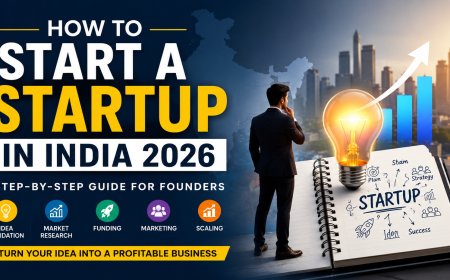

How to Start a Profitable Startup in India in 2026: Step-by-Step Guide for Founders
Learn how to start a profitable startup in India in 2026 with this complete step-by-step guide covering idea validation, funding options, legal setup, marketing strategies, customer acquisition, and scaling methods for aspiring founders to build a successful business from scratch.

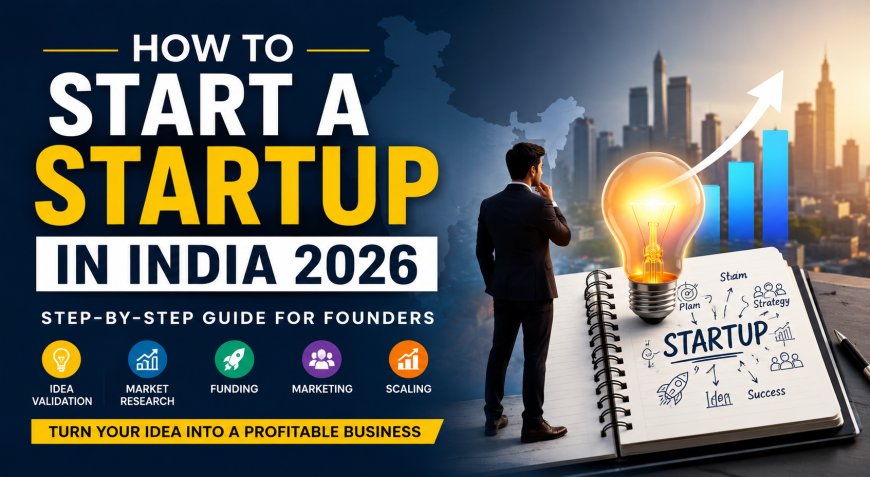
Starting a startup in India has never been more accessible than it is in 2026. With digital tools, AI automation, online funding platforms, and a rapidly growing consumer base, anyone with a strong idea and execution mindset can build a scalable business. However, accessibility does not mean simplicity. Most startups still fail because of poor planning, unclear validation, and weak execution strategies.
This guide is a complete, practical roadmap for anyone who wants to understand how to start a profitable startup in India in 2026—from idea selection to execution, funding, and scaling.
1. Understanding What a Startup Really Is
A startup is not just a small business. It is a scalable business model designed to grow fast using innovation, technology, or unique distribution methods.
Unlike traditional businesses:
- Startups focus on rapid growth
- They are built to attract investment (optional but common)
- They solve a specific problem in a scalable way
- They often rely on digital or tech-driven systems
In 2026, most successful startups in India fall into categories like:
- AI-powered services
- D2C (Direct-to-Consumer) brands
- SaaS platforms
- EdTech and skill-based learning
- Fintech solutions
- Creator economy tools
2. Choosing the Right Startup Idea
The biggest mistake new founders make is choosing an idea based on trend, not demand.
A good startup idea must pass three filters:
✔ Problem Validation
Ask:
- Is this a real problem or just a “nice-to-have” idea?
- Are people already spending money to solve it?
✔ Market Size
A startup should target a growing audience. For example:
- Small businesses in India
- Students & skill learners
- Local service providers
- Online consumers
✔ Monetization Clarity
If you cannot explain how you will make money in one sentence, the idea is not ready.
3. Market Research Before You Build Anything
Market research is where most founders skip steps—and later fail.
Here’s a simple process:
Step 1: Competitor Analysis
Check:
- Who is already solving this problem?
- What are they charging?
- Where are they weak?
Step 2: Customer Behavior
Understand:
- What are users currently using?
- Why are they unhappy with existing solutions?
Step 3: Demand Validation
Use:
- Google Trends
- Instagram search behavior
- Reddit/Quora discussions
- Keyword tools (SEO research)
If people are already searching for your solution, that’s a strong signal.
4. Building a Minimum Viable Product (MVP)
You don’t need a perfect product to start. You need a testable version.
An MVP can be:
- A simple website
- A landing page
- A WhatsApp-based service
- A basic app or prototype
The goal is not perfection—it is validation.
Ask:
- Will users pay for this?
- Will users come back again?
- Does it solve the core problem?
5. Legal Setup for Startups in India (2026)
Once your idea shows traction, set up legally:
Common structures:
- Sole Proprietorship (basic)
- Partnership Firm
- LLP (Limited Liability Partnership)
- Private Limited Company (best for scaling)
For serious startups, Private Limited is preferred because:
- Easier funding access
- Better credibility
- Limited liability protection
Basic registrations include:
- Company registration (MCA)
- GST registration
- Business bank account
- Trademark (recommended)
6. Funding Your Startup: Bootstrapping vs Investors
There are two main ways to fund a startup:
💰 Bootstrapping
You use your own money or revenue to grow.
Pros:
- Full control
- No pressure from investors
- Strong financial discipline
Cons:
- Slower growth
- Limited resources
💼 Investor Funding
You raise money from angel investors or VCs.
Pros:
- Fast scaling
- Marketing and hiring support
- Industry connections
Cons:
- Ownership dilution
- Performance pressure
In 2026 India, many startups start with bootstrapping and raise funding after traction.
7. Building Your First Customers
No startup succeeds without customers. Focus on early traction.
Best ways to get first users:
- Instagram and LinkedIn marketing
- Cold outreach (email/DM)
- Referral programs
- Local partnerships
- Influencer collaborations
Early stage goal:
👉 First 100 paying customers
Not followers. Not likes. Customers.
8. Marketing Strategy for New Startups
Marketing is not optional—it is survival.
Top channels in 2026:
- SEO (Google search traffic)
- Instagram reels (viral reach)
- YouTube Shorts (authority building)
- Paid ads (Google & Meta)
- Content marketing (blogs & podcasts)
A strong startup uses multi-channel visibility, not just one platform.
9. Scaling the Startup
Once you get product-market fit, focus on scaling:
Scaling strategies:
- Automate operations using AI tools
- Hire skilled freelancers or teams
- Expand to new cities or markets
- Improve retention, not just acquisition
Scaling is not about doing more—it is about doing things efficiently at a larger level.
10. Common Mistakes Founders Must Avoid
Most startups fail due to predictable reasons:
- Building without validation
- Copying competitors blindly
- Ignoring customer feedback
- Overspending too early
- Weak marketing strategy
- No clear monetization plan
Avoiding these alone increases success chances significantly.
11. Essential Tools for Startups in 2026
Modern startups rely heavily on tools:
- AI tools for content & automation
- CRM systems for customer tracking
- Analytics tools for performance
- Design tools for branding
- No-code platforms for MVP building
Using the right tools reduces cost and increases speed.
12. Final Thoughts
Starting a startup in India in 2026 is less about having a “perfect idea” and more about fast execution, validation, and adaptability.
The founders who win are not the ones with the best ideas—but the ones who:
- Execute quickly
- Learn from users
- Adapt continuously
- And build systems, not just products
If you can combine clarity of idea with disciplined execution, building a profitable startup is not just possible—it is highly achievable in today’s ecosystem.
What's Your Reaction?
 Like
1
Like
1
 Dislike
0
Dislike
0
 Love
0
Love
0
 Funny
0
Funny
0
 Angry
0
Angry
0
 Sad
0
Sad
0
 Wow
0
Wow
0